
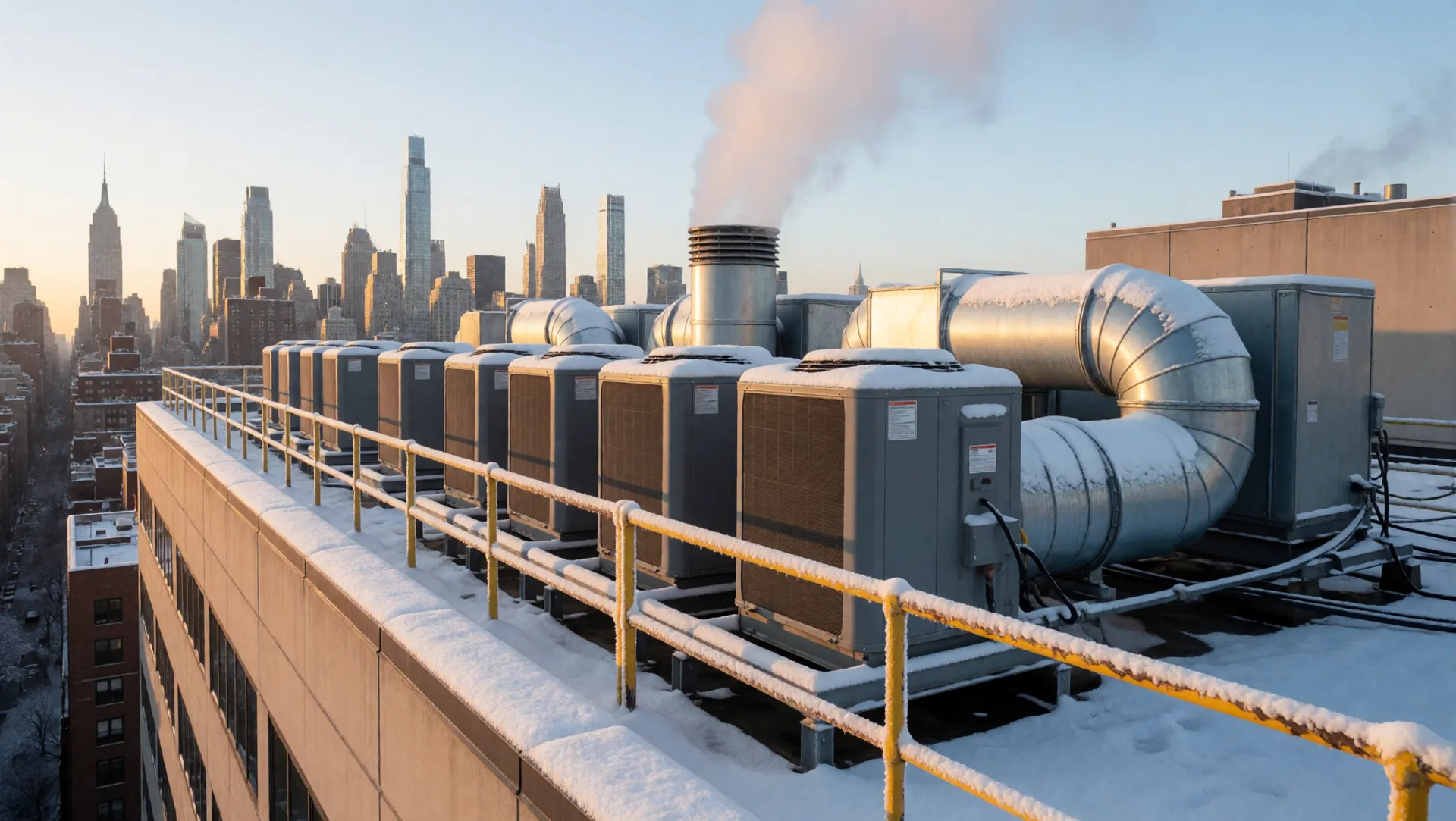
Winter 2026–27: NYC Metro HVAC Forecast.
Heating-season outlook for commercial building operators across New York City and Long Island. A potentially record-strength El Niño is building, and it changes which winter risks matter most for mechanical systems.
Lawrence Kirkorian
Principal, Icebox Mechanical Corp · EPA 608 Universal Technician (40 CFR Part 82, Subpart F) · OSHA 30 Crew Lead
Published September 2026 · Reality-check retrospective scheduled April 2027
What Does the Seasonal Outlook Say for Winter 2026–27?
The NOAA Climate Prediction Center's outlook for December 2026 through February 2027, updated on August 20, 2026, favors above-normal temperatures across the northern tier of the United States, including the Northeast, with a wetter-than-normal signal running up the East Coast. The driver is an El Niño that the Center describes as strengthening rapidly. Its August ENSO discussion put the odds of a very strong event during the Northern Hemisphere fall and winter above 90 percent, and gave a 69 percent chance that the October–December period exceeds the strength of every El Niño in the record dating back to 1950.
NYSERDA's published normals for New York City put December through February at roughly 2,700 base-65°F heating degree days, with January alone accounting for about 1,000. For commercial building operators in the NYC metro area, the most likely translation of the outlook is a winter with fewer sustained deep-cold stretches and a seasonal heating degree day total below that normal and well below the winter just past, but with more moisture in the pattern. Strong El Niño winters in New York have historically combined mild averages with an active southern storm track, which means heavy precipitation events, rain-to-snow changeovers, and the possibility of one major coastal storm even in an otherwise quiet season.
Seasonal outlooks are probabilistic. They express the likelihood of above-, near-, or below-normal conditions and do not predict individual storms or cold snaps. This page will be updated as the Climate Prediction Center issues its September and October outlooks.
How Did Last Winter Set Up This Season?
Winter 2025–26 was New York City's coldest and snowiest in eleven years. Central Park averaged 31.9°F, 4.3 degrees below normal, and recorded 43.4 inches of snow against a normal of roughly 30. A January 25 storm dropped 10.6 inches in Central Park, a weeks-long cold snap in late January and early February brought single-digit lows, and a February 22 blizzard delivered 19.7 inches, the ninth-largest snowstorm in the city's records.
Heating equipment across the region ran harder and longer than in any recent season. Heat exchangers cycled through more thermal stress, inducer motors and igniters accumulated starts, and hydronic systems ran at design load for weeks. Then the same rooftop equipment went straight into a record summer: Central Park reached 100°F on July 2, 2026, the first triple-digit reading there since 2012, followed by a run of 90-degree days that forecasters described as the longest in nearly a decade.
The practical consequence is that much of the installed base enters this heating season with a full year of high-stress operation behind it. Components that were marginal last spring may be more prone to failure in a second season if they are not inspected. That is the case for a thorough pre-season scope this fall regardless of how mild the outlook reads.
Why Is a Strong El Niño Winter Different for NYC Buildings?
The three strongest El Niño winters in the modern record offer useful benchmarks for how this pattern behaves in New York:
Winter 1997–98 — Mild and Snow-Starved
The benchmark super El Niño produced one of the mildest winters in Central Park records, with February 1998 running far above average and very little accumulating snow until March. Heating demand was far below normal, but midwinter warm spells left many buildings calling for cooling and heating in the same week.
Winter 2015–16 — Mild December, Then a Record Blizzard
December 2015 was the warmest December in Central Park records, and then the January 23, 2016 blizzard dropped more than 27 inches in Central Park, the largest single-storm total the station has recorded. Seasonal snowfall still finished below normal. This is the El Niño signature operators should plan around: quiet weeks punctuated by one event that overwhelms roof drainage, buries outdoor units, and strands service crews.
Winter 1982–83 — Warm Start, Major February Storm
December 1982 ran well above average, and the season still delivered a major nor'easter in February with heavy, wet snow. Wet snow loads and rapid freeze-thaw cycling, rather than sustained cold, defined the mechanical problems that winter.
The common thread is moisture. Wet cold in the 30s with high humidity is a harder operating band for rooftop equipment than dry cold in the teens: heat pump and VRF outdoor coils frost and defrost repeatedly, economizer dampers and louvers ice, condensate from high-efficiency equipment freezes in drain lines, and rain-on-snow followed by a hard freeze dams roof drains around equipment curbs. Buildings that winterized for last year's deep cold should re-check the moisture-related items on this list.
What Should Building Operators Do Before Heat Season?
New York City's heat season runs from October 1 through May 31. The items below represent the mechanical scope of pre-season readiness, the kind of work performed under preventive maintenance or service-contract coverage. Starting in September leaves time to source parts before the first cold morning.
The sequence matters: combustion and safety checks first, then freeze protection and dampers, then controls, so that a fault found early can be corrected before the plant is needed.
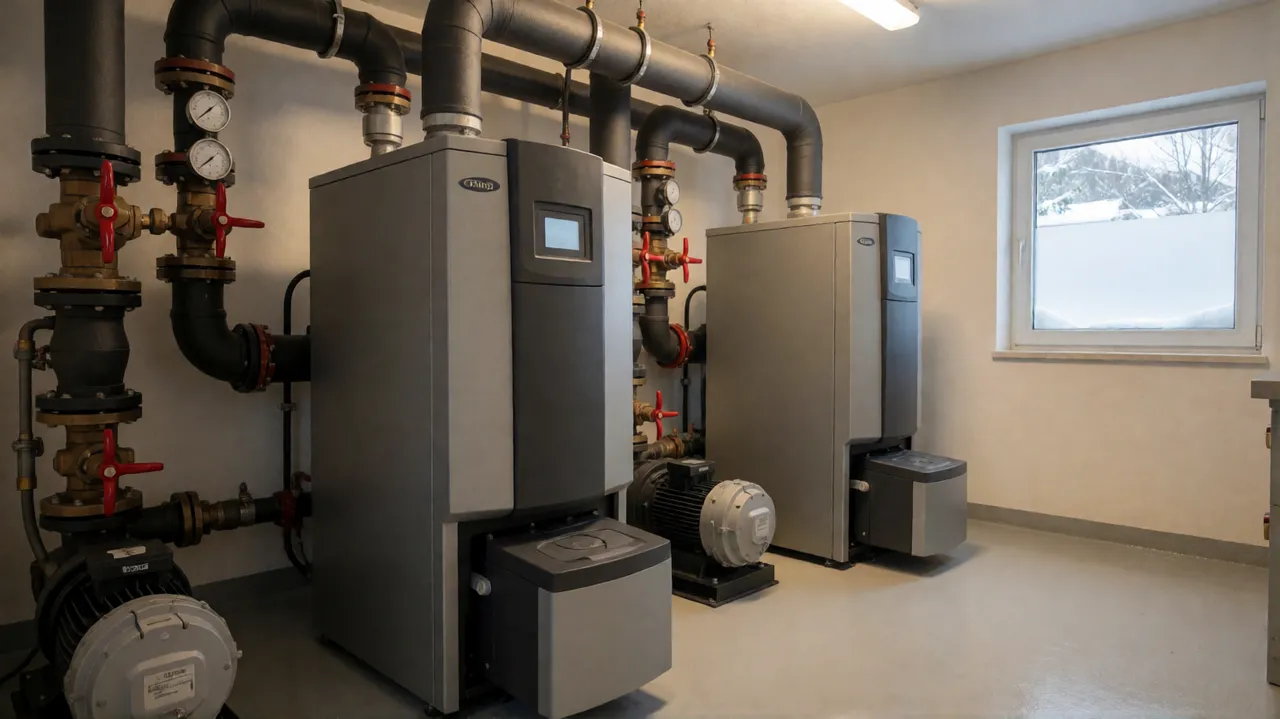
Step 01
Heat exchangers and combustion
Inspect gas-fired rooftop unit and furnace heat exchangers for cracks and corrosion, run a combustion analysis, and tune burners. A cracked heat exchanger can allow combustion gases, including carbon monoxide, into the supply air and should be evaluated promptly.
Step 02
Ignition and draft components
Test igniters, flame sensors, pressure switches, and inducer motors under load. These components produce many of the no-heat calls on the first cold morning of the season.
Step 03
Boiler diagnostics and controls
Verify low-water cutoffs, operating and high-limit controls, and pump operation on hydronic systems. Icebox troubleshoots and services existing boiler systems; new boiler installation is outside its scope.
Step 04
Freeze protection
Test freeze stats and low-limit sequences on air handlers, confirm glycol concentration on exposed hydronic loops, and confirm heat trace on condensate lines from condensing equipment.
Step 05
Economizers and dampers
Cycle outside-air dampers and actuators, verify minimum positions, and check that seals close fully. Iced or stuck-open dampers freeze coils and drive heating loads up on the coldest days.
Step 06
Heat pumps and VRF outdoor units
Verify defrost operation, confirm outdoor units are elevated on stands with drainage clear of the snow line, and check refrigerant charge. Wet cold in the 30s is the hardest operating band for these systems.
Step 07
Rooftop drainage and curbs
Clear roof drains and scuppers around equipment curbs. Rain-on-snow followed by a hard freeze creates ice dams that flood curbs and back water into unit cabinets.
Step 08
Cooling-side winterization
Drain or protect cooling towers and condenser water piping, confirm basin heaters, and isolate chilled-water coils that are not freeze-protected.
Step 09
Controls and sequences
Load heating schedules and setpoints into the building automation system, verify sensor calibration after the summer, and confirm the changeover logic will not call for cooling and heating at the same time during December warm spells.
Step 10
Heat-season compliance monitoring
For multi-unit residential buildings, confirm space temperatures can be verified apartment by apartment, and keep service records current. See the enforcement note below.
What Equipment Is Most at Risk in a Wet, Freeze-Thaw Winter?
A milder, wetter pattern shifts the failure modes operators should expect. The table below ranks the components most exposed to this winter's likely conditions and the prevention step that addresses each one.
| Component | Failure Mode | Prevention |
|---|---|---|
| Heat Exchangers | Thermal-cycling cracks after a season of heavy runtime; flue gas and carbon monoxide leakage into supply air | Visual and combustion-analyzer inspection, CO testing at the supply, burner tuning |
| Economizer Dampers | Ice locks blades open or closed; stuck-open dampers freeze downstream coils and spike heating load | Cycle actuators, replace worn seals, verify minimum-position and low-ambient lockout |
| Heat Pump / VRF Outdoor Coils | Frost accumulation and repeated defrost in humid 30s; snow ingestion and drainage ice at the base | Verify defrost sensors and sequences, raise units on stands, keep drainage and clearances clear |
| Condensate Drains | Condensing furnaces and rooftop units flood or lock out when drain lines freeze | Heat trace and insulate exterior runs, confirm traps and slope, test the overflow switch |
| Air Handler Coils | Coil freeze when a preheat or freeze stat fails during a cold snap after a mild spell | Test freeze stats and low-limit sequences, confirm glycol concentration, verify damper interlocks |
| Igniters, Flame Sensors, Inducers | Nuisance lockouts and no-heat calls on the first cold morning after accumulated starts last winter | Test-fire under load in September, clean flame sensors, replace weak igniters and inducer bearings |
| Roof Drains and Curbs | Rain-on-snow and refreeze create ice dams that pond water at curbs and inside unit cabinets | Clear drains and scuppers before the season, inspect curb flashing, plan snow-removal paths around equipment |
What Does the New Heat-Season Enforcement Mean for Multi-Unit Buildings?
As of September 2026, the heat-season requirements themselves are unchanged: between 6 a.m. and 10 p.m., residential spaces must be heated to at least 68°F when the outdoor temperature falls below 55°F, and to at least 62°F overnight regardless of the outdoor temperature. What is reported to change on October 1, 2026 is enforcement. According to guidance published ahead of the 2026–27 season, the NYC Department of Housing Preservation and Development intends to investigate every heat complaint as an individual case rather than consolidating multiple complaints from one property into a single building case. Owners should confirm current complaint-handling practice with HPD directly.
For property managers and operators of luxury multi-unit buildings, that puts more weight on being able to show that each reported apartment is at temperature, not only that the boiler or rooftop plant is running. Zone balancing, thermostat and sensor calibration, and documented service history matter more under that standard. Mechanical items that commonly produce a warm plant and a cold apartment include failed zone valves, air-bound hydronic risers, stuck dampers, and control sequences that were never re-tuned after summer.
Heat-season requirements are administered by New York City agencies. This section is a general summary of publicly available agency guidance as of September 2026, is not legal advice, and should be verified against current official sources.
How Will Refrigerant Rules Affect Heat Pump and VRF Work This Winter?
Winter is when many replacement and retrofit decisions for cooling and heat-pump equipment are planned, and the rules moved during 2026. As summarized by industry associations, a May 2026 EPA final rule lifted the federal January 1, 2026 prohibition on installing residential and light-commercial R-410A air conditioners and heat pumps manufactured before 2025, with the change effective July 27, 2026. New York's rules differ: the state's Part 494 regulation keeps the January 1, 2026 installation deadline in effect for those equipment classes, so replacement planning in New York should assume A2L refrigerants such as R-454B or R-32 for new split and heat-pump equipment. Requirements should be confirmed with the EPA and the New York State Department of Environmental Conservation before equipment is specified.
Routine service of existing R-410A equipment continues, subject to EPA Section 608 and applicable state requirements: leak repair, recovery, and recharge are performed as before. Supply of R-454B, which was tight through much of 2025, had substantially improved by late summer 2026 according to distributor reporting, but inventory should still be confirmed before a replacement is scheduled. Packaged rooftop equipment falls under separate compliance dates in the federal rule, so the applicable date should be confirmed for the specific equipment class before it is specified.
A2L refrigerants are classified as mildly flammable, which brings updated handling, leak-detection, and installation practices. Building operators specifying heat-pump or VRF replacements this winter should confirm that the equipment, the controls, and the service provider's procedures all match the refrigerant class being installed.
What About Heating Energy Costs This Winter?
The wholesale picture is calmer than a year ago. The U.S. Energy Information Administration's August 2026 Short-Term Energy Outlook expects the Henry Hub natural gas spot price to stay below $3.00 per MMBtu until November, with inventories projected to reach a record 3,985 billion cubic feet at the end of October, about 5 percent above the five-year average. High storage heading into winter usually keeps commodity prices moderate unless a prolonged cold outbreak draws it down quickly.
The delivery side is where New York bills are moving. Con Edison's most recent gas rate filing with the state Public Service Commission sought roughly an 18.8 percent increase in base delivery revenue, and National Grid customers on Long Island and in the outer boroughs have also seen delivery rates rise. Northeast natural gas prices rose about 37 percent between 2020 and 2025 according to federal data, and customers saw bills spike during last winter's cold snap. In a milder winter the volume of fuel burned may fall, but the fixed and delivery components of the bill do not.
Within mechanical scope, the items that can lower fuel use are combustion tuning, correct outside-air minimums, verified heating schedules and setbacks, and heat-pump changeover setpoints that avoid running auxiliary heat when it is not needed. Icebox does not model or project savings; these items are part of routine heating-season service and are documented in the client portal after each visit.
How Will Icebox Update This Forecast?
This forecast reflects data available as of September 2, 2026. The Climate Prediction Center issues updated seasonal outlooks in mid-September and mid-October, and its official winter outlook in October. This page will be updated if those releases change the temperature or precipitation signal for the Northeast.
In April 2027 a reality-check retrospective will be appended to this page, comparing the outlook against observed conditions: seasonal heating degree days, notable storms and cold snaps, and the equipment failure patterns Icebox crews actually saw. The Summer 2026 forecast already carries its retrospective, scored against Central Park's June–August data.
This forecast is provided for informational purposes and is not a substitute for real-time weather monitoring, professional energy consulting, or engineering analysis. Icebox Mechanical Corp does not provide energy audits, energy benchmarking, or quantified savings projections.
Sources
NOAA Climate Prediction Center, ENSO Diagnostic Discussion (August 13, 2026) and seasonal outlook update (August 20, 2026).
NYSERDA, Heating Degree Day Information for New York City (30-year normals).
CBS New York, winter 2025–26 season recap (March 21, 2026); National Weather Service New York, Central Park observations.
U.S. Energy Information Administration, Short-Term Energy Outlook (August 2026).
NYC Department of Housing Preservation and Development, heat and hot water guidance; New York State Department of Public Service, pending gas rate cases.
ACCA, EPA R-410A installation deadline rule summary (May 22, 2026); HARDI distributor reporting on R-454B supply (2026).
Forecast FAQ
Preparing your building for this winter?
Contact Icebox Mechanical Corp to discuss pre-season heating inspection, service contract coverage, or equipment readiness for the heat season ahead.